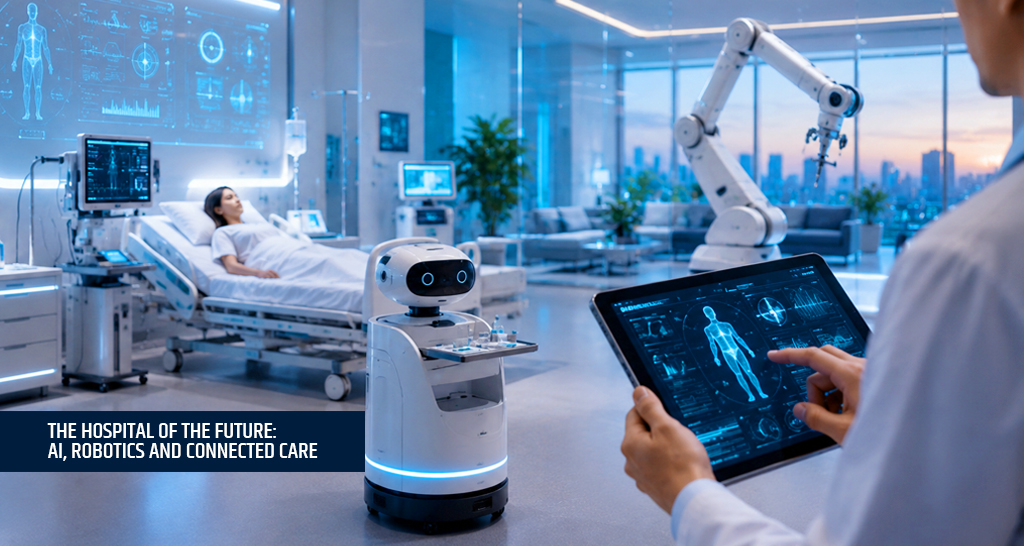
Healthcare is entering a new era in which the hospital is no longer defined simply by its buildings, beds, operating rooms, and medical equipment. The hospital of the future will be an intelligent, connected ecosystem where artificial intelligence, robotics, advanced analytics, smart infrastructure, and virtual care work together to make healthcare more proactive, personalized, efficient, and accessible.
In 2026, healthcare organizations are increasingly exploring how generative AI, agentic AI, connected devices, remote monitoring, and digital experiences can transform both clinical and operational processes. Deloitte identifies scaling AI, digital consumer experiences, and care-delivery transformation among the major strategic priorities for healthcare organizations.
From Traditional Hospitals to Intelligent Healthcare Ecosystems
Traditional hospitals have largely operated around a facility-centered model: patients arrive at a hospital, receive treatment, and return home. The emerging model is different. Care is increasingly organized around the patient rather than the facility, connecting hospitals with homes, wearable devices, virtual consultations, remote monitoring, pharmacies, laboratories, and community healthcare services.
Smart healthcare facilities are already being designed as connected ecosystems integrating technologies such as AI, IoT-enabled devices, digital engagement platforms, sensors, and connected-room systems.
This transformation could fundamentally change how healthcare organizations manage everything from patient admissions and hospital capacity to diagnostics, treatment, discharge planning, and long-term care.
AI as the Hospital’s Intelligence Layer
Artificial intelligence will be one of the most important technologies shaping the hospital of the future.
AI can analyze enormous volumes of clinical and operational data, identify patterns, support clinical decision-making, automate administrative work, and help healthcare professionals prioritize patients who may require immediate attention.
The opportunity extends beyond conventional AI. Generative AI and agentic AI are increasingly being explored for workflows that require reasoning, coordination, and automation across multiple functions. Deloitte’s 2026 global outlook notes that healthcare organizations are looking toward AI to improve operational efficiency, automate workflows, support clinicians, and enable more proactive care.
However, the future of AI-powered healthcare should not be viewed as a replacement for physicians and nurses. Instead, AI’s greatest value may come from augmenting human expertise—giving clinicians better information at the right time while allowing them to spend more time on patients.
Responsible implementation will be essential. WHO emphasizes the importance of human oversight, governance, transparency, equity, and risk management when implementing AI in healthcare.
Robotics: From the Operating Room to the Hospital Floor
Robotics is another major component of the future hospital.
Robotic-assisted surgery is already changing how certain procedures are performed, but the role of robotics could extend much further. Future hospitals may increasingly use robots for logistics, medication delivery, monitoring, transportation, sanitation, rehabilitation, and selected clinical tasks.
The combination of robotics and AI could create a new generation of intelligent machines capable of assisting healthcare professionals with increasingly sophisticated tasks. Deloitte notes that robotics is becoming more prominent in healthcare, while the combination of robotics and AI could move healthcare technology beyond decision support toward physical, embodied assistance.
Importantly, this does not mean hospitals will become places without human interaction. Rather, robotics could take on repetitive or physically demanding tasks, allowing healthcare professionals to focus more heavily on clinical judgment, communication, empathy, and complex patient needs.
Connected Care: Healthcare Beyond Hospital Walls
Perhaps the biggest transformation will be the shift from hospital-centered care to connected care.
Wearable devices, remote patient monitoring, smart medical devices, connected implants, virtual consultations, and home-based technologies can allow healthcare professionals to monitor patients beyond traditional clinical settings.
Instead of waiting for a patient to return for a scheduled appointment, healthcare providers could receive continuous or near-real-time information about relevant health indicators and intervene earlier when concerning changes appear.
Connected care can also support patients with chronic conditions by reducing unnecessary hospital visits and enabling more convenient ongoing management. Deloitte’s research highlights remote monitoring, virtual health, and connected devices as important elements of evolving care models.
This represents a fundamental change in philosophy: healthcare becomes more continuous rather than episodic.
The Rise of Predictive and Preventive Healthcare
The hospital of the future will not simply become better at treating disease. It will increasingly aim to predict and prevent health problems before they become serious.
AI-powered analytics can potentially combine information from electronic health records, medical imaging, laboratory results, wearable devices, genetics, and other data sources to identify risk patterns.
For example, predictive systems could help identify patients at higher risk of complications, deterioration, readmission, or other adverse outcomes, allowing care teams to intervene earlier.
This supports the broader transition from a reactive model—diagnose, treat, recover—toward a proactive model focused on predict, prevent, personalize, and continuously monitor.
Deloitte’s 2026 global healthcare outlook similarly identifies preventive care, early detection, remote monitoring, and proactive care models as important directions for health systems.
Smart Infrastructure and Digital Hospital Operations
Technology will not only transform medical care; it will transform the physical hospital itself.
Future facilities may use sensors and connected systems to monitor equipment, patient movement, environmental conditions, energy consumption, room availability, and operational performance.
AI-powered command centers could provide hospital leaders with a real-time view of patient flow, staffing, resources, and capacity. Digital systems could help predict demand and coordinate resources before bottlenecks occur.
Modern healthcare facilities are also being designed with infrastructure capable of supporting AI, IoT, robotics, advanced connectivity, and flexible clinical environments.
The result could be a hospital that is not only technologically advanced but also more efficient, adaptable, and resilient.
Putting the Patient at the Center
Technology alone will not define the hospital of the future.
The real measure of transformation will be whether technology creates a better patient experience.
Patients increasingly expect healthcare to be convenient, personalized, transparent, and digitally accessible. Scheduling, registration, communication, payments, virtual consultations, test results, medication reminders, and follow-up care can increasingly be connected through digital platforms.
But personalization must not come at the expense of human connection.
The most successful hospitals will therefore combine digital convenience with human compassion. Technology should remove friction from the patient journey—not remove people from it.
The Human Workforce Will Remain Essential
As technology becomes more capable, healthcare professionals will remain at the center of care.
AI can analyze data. Robots can perform physical tasks. Connected devices can continuously collect information. But physicians, nurses, therapists, technicians, and other healthcare professionals provide something technology cannot fully replicate: human judgment, empathy, trust, communication, and accountability.
At the same time, healthcare organizations will need to prepare their workforce for a technology-enabled environment. WHO’s 2026 workforce analysis highlights continuing challenges involving workforce availability, distribution, and long-term workforce planning.
The future healthcare workforce will therefore need both clinical expertise and digital fluency.
Building Trust in the Digital Hospital
With greater connectivity comes greater responsibility.
Hospitals will manage enormous volumes of sensitive patient information, making cybersecurity, privacy, data governance, interoperability, and responsible AI essential components of digital transformation.
Healthcare leaders must ask important questions before deploying new technologies:
- Is the technology clinically safe?
- Is patient data protected?
- Can clinicians understand and challenge AI-generated recommendations?
- Does the system introduce bias?
- Can it integrate with existing workflows?
- Does it create measurable value?
- Who is accountable when something goes wrong?
WHO’s recent work on AI in healthcare emphasizes that innovation must be accompanied by governance, safety, equity, transparency, and appropriate human oversight.
The Future Is Connected—But Still Human
The hospital of the future will not be defined by how many robots it owns or how advanced its AI platform is. Its success will be measured by better outcomes, faster and safer care, improved access, greater efficiency, stronger patient experiences, and healthier communities.
AI can provide intelligence. Robotics can provide physical assistance. Connected devices can provide continuous information. Smart infrastructure can coordinate the environment. But healthcare professionals will continue to provide the human judgment and compassion that make care meaningful.
The future hospital, therefore, is not a hospital without people. It is a hospital where people and technology work together more intelligently.
As healthcare moves toward connected, predictive, and personalized models, organizations that successfully integrate technology with clinical expertise and human-centered leadership will be best positioned to shape the next generation of healthcare.
Conclusion
The transformation of healthcare is no longer simply about adopting new medical technologies. It is about redesigning the entire healthcare ecosystem.
The hospital of the future will extend beyond its walls, use AI to turn data into actionable insights, deploy robotics to support clinical and operational teams, and connect patients with care wherever they are.
The ultimate goal is simple: better healthcare, delivered smarter, earlier, and more personally.
And as the healthcare industry enters this new era, the most successful hospitals will not be those that merely adopt the most technology—but those that know how to use technology to create better human care.