
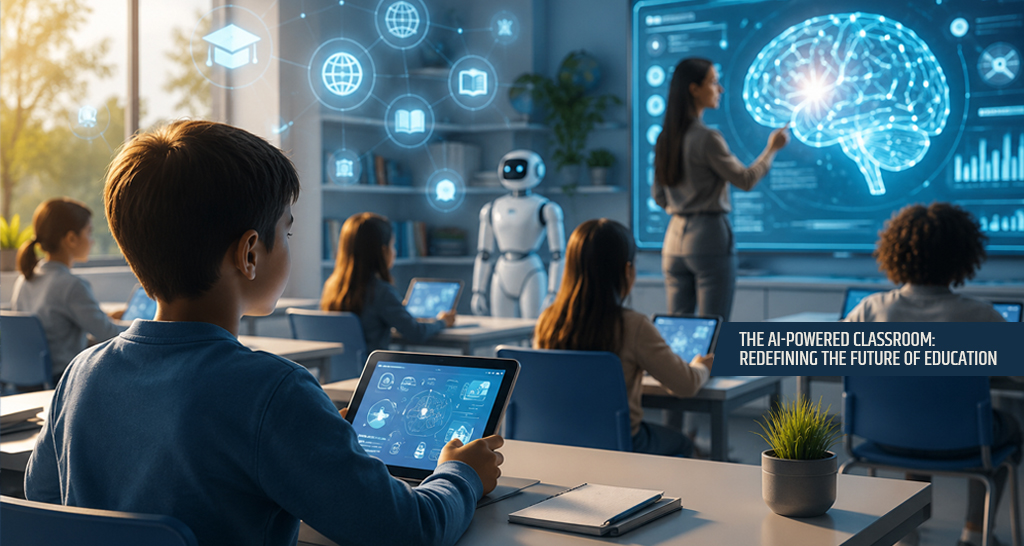
Education is entering a transformative era. Artificial intelligence is no longer a futuristic concept limited to technology companies—it is becoming an increasingly important part of how students learn, teachers teach, and institutions operate. From intelligent tutoring systems to personalized learning platforms, AI is helping create classrooms that are more adaptive, engaging, and responsive to individual student needs.
The AI-powered classroom is not about replacing teachers with machines. Instead, it is about combining human expertise with intelligent technology to create better learning experiences and prepare students for a rapidly changing world.
Personalized Learning for Every Student
One of the greatest advantages of AI in education is its ability to personalize learning. Traditional classrooms often follow a standardized pace, even though students have different strengths, weaknesses, interests, and learning styles.
AI-powered platforms can analyze learning patterns and identify areas where students may need additional support. They can recommend suitable resources, adjust the difficulty of exercises, and provide immediate feedback. This creates a more individualized learning journey while helping educators understand where students may be struggling.
Personalized learning can also encourage students to take greater ownership of their education. Instead of simply following a fixed curriculum, learners can receive targeted support that matches their current abilities and progress.
Empowering Teachers, Not Replacing Them
Despite concerns surrounding AI, the future of education is unlikely to be about replacing teachers. The most valuable role of AI may be empowering educators to focus more on teaching, mentoring, creativity, and human connection.
AI can assist teachers with administrative tasks such as generating lesson ideas, creating practice materials, analyzing assessments, and organizing learning resources. By reducing repetitive workloads, educators can spend more time interacting with students and providing meaningful guidance.
The teacher therefore remains central to the classroom—but with a powerful digital assistant capable of supporting many aspects of the learning process.
Intelligent Tutoring and Real-Time Support
AI-powered tutoring systems are also changing how students access academic assistance. Intelligent systems can provide explanations, practice questions, hints, and feedback based on a student’s responses.
This can be particularly valuable outside traditional classroom hours. Students no longer have to wait until the next lesson to identify a problem or seek clarification. AI tools can provide immediate assistance while allowing teachers to monitor overall progress.
However, technology should complement—not replace—human mentorship. Teachers provide emotional intelligence, context, encouragement, and judgment that AI cannot fully replicate.
Developing Future-Ready Skills
The workplace of tomorrow will demand more than academic knowledge. Students will need to develop critical thinking, creativity, communication, collaboration, adaptability, and digital literacy.
As AI handles more routine and repetitive tasks, uniquely human capabilities may become even more valuable. Schools and universities therefore have an opportunity to move beyond memorization and focus more strongly on problem-solving and real-world application.
Students should not only learn how to use AI, but also how to question its outputs, evaluate information, recognize limitations, protect privacy, and use technology responsibly.
The Growing Importance of AI Literacy
AI literacy is becoming an important component of modern education. Understanding how AI systems work at a basic level can help students become more informed users and future professionals.
Educational institutions can introduce students to concepts such as machine learning, generative AI, responsible AI use, data privacy, algorithmic bias, and digital ethics. These lessons can help create a generation that is capable of using powerful technologies thoughtfully rather than simply consuming them.
Challenges That Education Leaders Must Address
The adoption of AI also comes with important challenges. Schools and universities must consider data privacy, cybersecurity, academic integrity, unequal access to technology, algorithmic bias, and the potential misuse of generative AI.
There is also a risk that excessive dependence on technology could reduce independent thinking if students simply accept AI-generated answers without questioning them.
For this reason, successful AI adoption requires clear policies, teacher training, responsible technology selection, and strong digital citizenship education. Technology should serve educational objectives—not become the objective itself.
Building the Classroom of Tomorrow
The classroom of the future will likely combine physical and digital experiences. Students may learn through interactive simulations, AI tutors, virtual environments, collaborative platforms, and adaptive educational content while continuing to benefit from face-to-face interaction with teachers and classmates.
This hybrid approach can make education more flexible and accessible while maintaining the human relationships that make learning meaningful.
The most successful institutions will not necessarily be those that adopt the most technology. They will be those that understand where technology creates genuine educational value and where human expertise remains indispensable.
Conclusion
The AI-powered classroom represents more than a technological upgrade—it represents a fundamental opportunity to rethink how education works.
AI can personalize learning, support teachers, provide faster feedback, and help students develop skills for an increasingly digital economy. But its true potential will depend on how thoughtfully educators and institutions implement it.
The future of education should not be AI versus teachers. It should be AI working alongside teachers to create more personalized, inclusive, creative, and human-centered learning experiences.
The classroom of tomorrow will be powered by technology—but its greatest strength will remain human potential.